A DIY Blueprint Guide Inspired by Nikola Tesla's Bifilar Pancake Coil — Explained Honestly
The Energy Revolution System is a digital PDF blueprint set that walks you through a concept device based on Nikola Tesla's 1894 Bifilar Pancake Coil idea. This review explains what's actually inside, how the theory is presented, what realistic expectations look like, and what safety and cost factors to consider — before you decide.
⚡ Instant PDF access via official vendor · Affiliate link — we may earn a commission at no extra cost to you
ℹ️ Not a magic free-energy device. Educational DIY guide. Results vary. Professional electrical advice recommended.A digital blueprint package — not a factory-made generator you plug in — teaching a concept device inspired by a 19th-century Tesla coil design.
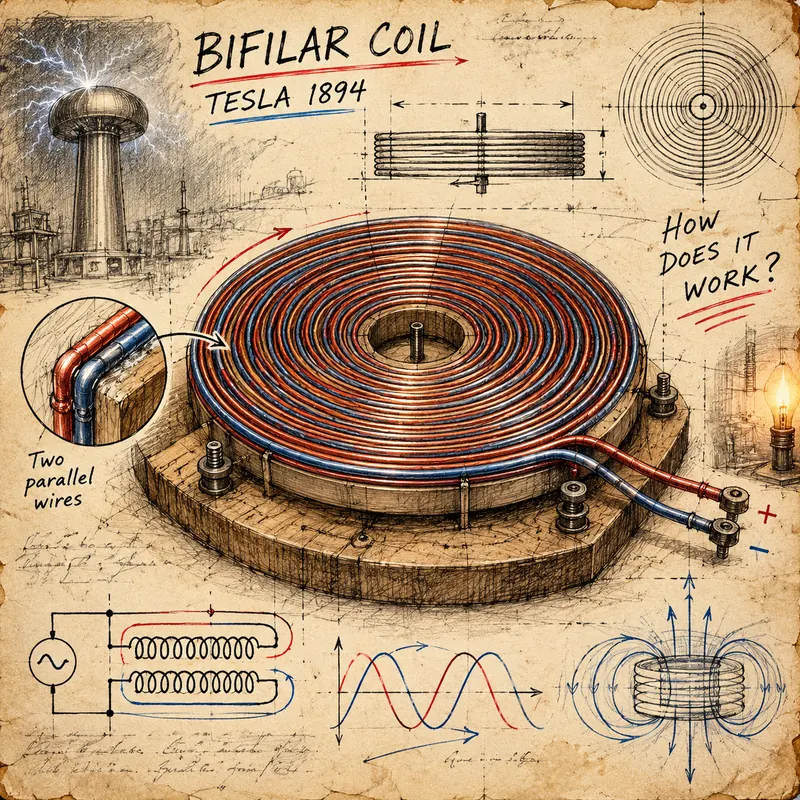
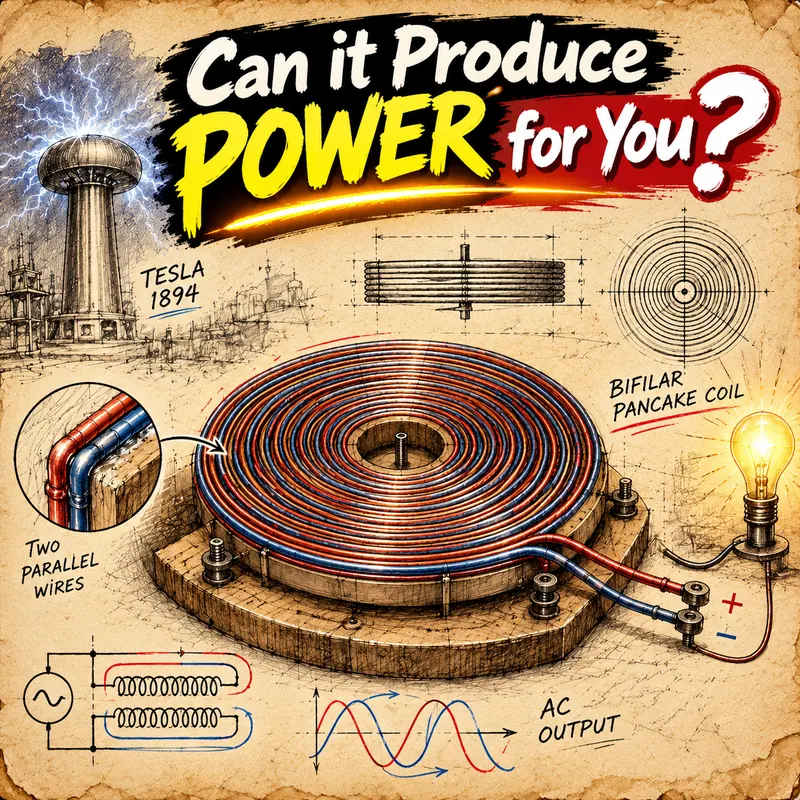
The Energy Revolution System PDF Blueprints, created by Michael Garnett, are presented as a detailed, educational guide for building a small-scale conceptual device inspired by Nikola Tesla's Bifilar Pancake Coil. First described by Tesla in 1894, the pancake coil uses two closely wound parallel windings arranged in a flat spiral. In Tesla's writings, this geometry was explored for its ability to store energy differently than a standard coil, acting partly like a capacitor and influencing how it handles voltage and resonance.
It is important to be clear about what this product is — and what it is not. It is a digital, instructional PDF that includes schematics, a parts list, build guidance, and general maintenance notes. It is not an approved, mass-manufactured power generator, it is not a certified replacement for your home's electrical service, and it does not promise to eliminate your electric bill. Like any DIY electrical project, the outcome will depend heavily on your skill level, the quality of components you choose, how accurately you follow instructions, local electrical codes, and ongoing maintenance.
According to the materials, the guide is aimed at homeowners, small-business owners, renters seeking to learn about alternative energy concepts, and DIY enthusiasts who enjoy hands-on projects. The creator's stated goal is to make an energy-efficiency concept more accessible through clear diagrams and beginner-friendly language. That accessibility can be helpful for learning, but it does not remove the need for caution. Working with electrical components carries risk, and where local regulations apply, a licensed electrician should be consulted before connecting anything to a home's electrical system.
From an educational standpoint, many readers approach this guide out of curiosity about Tesla's work and a broader interest in renewable energy, which has grown significantly. Industry reports cited in the source PDF note that more than 48 gigawatts of renewable capacity were added in a single recent year, reflecting public interest in lower-carbon options. The Energy Revolution System positions itself as a small, experimental complement to that larger conversation — a way to explore coil-based concepts at home — rather than a proven, grid-scale solution.
Think of this as an educational blueprint for an experimental build, not a guaranteed home power plant. Any discussion of savings or efficiency should be viewed as theoretical and highly dependent on your execution, local electricity rates, and whether the device is used safely and legally. If you are looking for a certified, utility-approved way to reduce dependence on the grid today, options like improving insulation, using Energy Star appliances, and consulting a licensed solar professional about permitted rooftop solar are more established paths.
Official vendor checkout · Learn about current pricing & guarantee details
Household electricity costs are a regular concern for many families. Rates vary by state and utility, and they can rise with fuel costs, grid maintenance needs, and seasonal demand. For some households, even modest increases add pressure to monthly budgets. That pressure is one reason interest in home efficiency projects — from weatherization to DIY solar kits — has remained steady.
Beyond cost, there is also a growing interest in resilience and sustainability. Some homeowners want to understand where their electricity comes from and how to use less of it. Others enjoy learning the hands-on skills behind electrical and mechanical systems. A guide like the Energy Revolution System appeals to that second group: people who like to learn by building and who are curious about historical inventors like Tesla.
It helps to keep both motivations in perspective. Reducing your environmental footprint and improving energy efficiency are worthwhile goals, and small behavioral changes (LED lighting, smart thermostats, proper insulation) often deliver the most predictable returns. Experimental DIY energy builds can be an engaging educational supplement, but they are best approached with careful expectations, an understanding of electrical safety, and respect for local building and electrical codes. If you envision a project that would connect to your home wiring, plan to involve a qualified professional from the start.
This review was written after analyzing the Energy Revolution System PDF text, publicly available descriptions of Tesla's Bifilar Pancake Coil, and general information about home energy options. We did not independently build or laboratory-test a device from the blueprints, and we do not present the guide's theoretical claims as independently verified facts. Instead, we summarize what the guide says, add context that may help you evaluate it, and point out where professional advice is appropriate.
More households track usage and look for efficiency gains — LED upgrades, insulation, and appliance choices.
Tesla's legacy inspires makers who want to understand coils, fields, and energy transfer concepts.
Renewable adoption grows yearly, making DIY learning projects an engaging entry point.
A high-level, non-technical overview of the historical concept referenced in the blueprints. This is educational context, not an engineering endorsement.
In Tesla's writings, a Bifilar Pancake Coil is wound as a flat spiral with two conductors laid parallel to each other, closely spaced, then connected in a way that the coil exhibits both inductance and capacitance. That combination can affect the coil's resonant behavior compared with a conventional cylindrical coil. In the Energy Revolution System materials, this property is highlighted as the theoretical basis for exploring more efficient energy transfer under specific resonant conditions.
The PDF describes the idea that when such a coil is driven at or near its natural resonant frequency, it can produce interacting magnetic and dielectric fields. The materials go on to suggest that this could allow voltage to be developed nearby or transferred in unusual ways, including references to single-wire transmission concepts Tesla explored. These are historical, theoretical descriptions. Whether and how they translate into a practical, safe, and code-compliant home device is precisely where careful building, testing, and professional oversight would be essential.
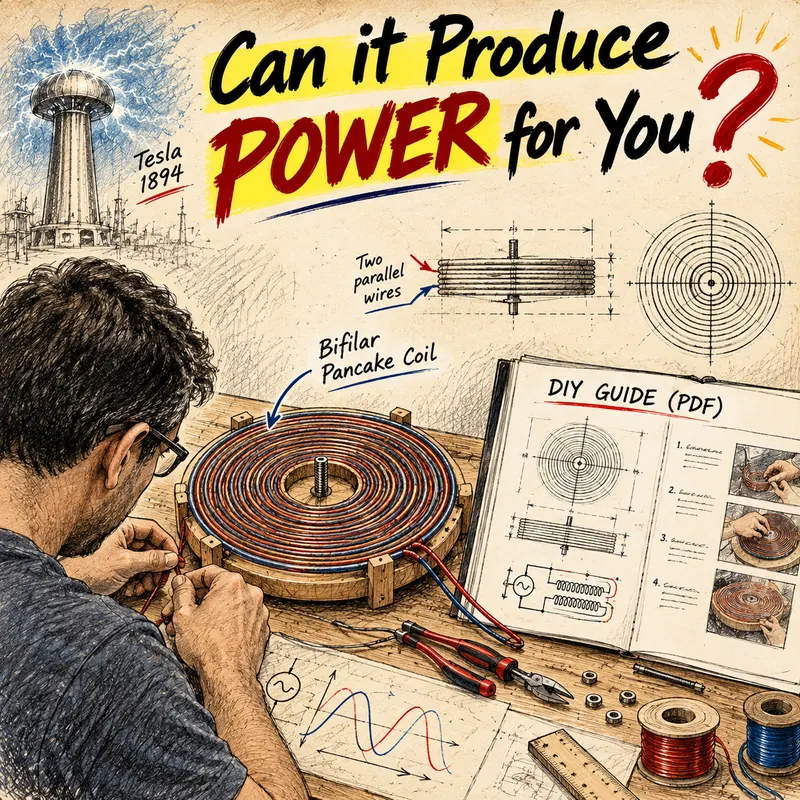
According to the guide, you will source common electrical parts — magnet wire, capacitors, diodes, an inverter-related section, and supporting hardware — then assemble them on a frame following the provided schematics. The guide reportedly includes a parts list with suggested specifications, step-by-step build photos or diagrams, and notes on placement and basic troubleshooting. The PDF also emphasizes using responsibly sourced, appropriately rated components rather than improvised substitutes.
References in the source material to concepts like the "3rd positive Electromotive Force (EMF)" or laboratory efficiencies over 100% are presented as theoretical discussion from certain inventors and papers, not as universally accepted electrical engineering outcomes. In mainstream electrical engineering, efficiency over 100% would imply a violation of conservation of energy and requires extraordinary, peer-reviewed proof. This guide should be approached as an educational exploration of Tesla's ideas, not as a proven method to generate unlimited power. Always prioritize safety, and do not attempt to back-feed your home's panel without licensed professional involvement and utility permission.
Concept illustration above — full step-by-step schematics are provided in the official PDF via the vendor.
View Official Blueprints →Diagrams showing coil layout, wiring paths, and component placement intended to help you understand how each part fits together.
A shopping list of suggested wire gauges, capacitors, diodes, fasteners and frame materials, with notes on ratings and sourcing.
Sequential instructions designed to be followed with basic hand tools, including placement tips and wiring checkpoints.
General upkeep guidance and reminders to inspect connections, respect ratings, and consult a professional for anything tied to household wiring.
Notes on scaling the concept for different spaces, with emphasis on staying within safe, low-voltage learning contexts where appropriate.
A guide can teach concepts, but it cannot guarantee a specific power output, bill reduction, or utility approval. Your experience will vary with parts quality, build accuracy, environmental factors, and safe installation practices. If you plan to do more than a bench-top learning build, budget for professional review.
Digital download · Vendor handles billing & guarantee terms
The materials are presented as beginner-friendly, with language and illustrations meant to help readers who do not have an engineering background. That can make the history of Tesla's work more engaging. At the same time, even a "beginner-friendly" electrical project deserves respect. Understanding wire ratings, insulation, grounding, fuse protection, and enclosure practices matters. A guide that is easy to read still requires careful, patient execution.
The PDF also positions the project as an exploration of green-energy thinking — learning about resonance, fields, and efficiency concepts. Viewed as a STEM learning project, it can be an interesting way to deepen your understanding of coils and circuits. Viewed as a guaranteed revenue or bill-elimination tool, it would be setting the wrong expectation. Any financial comparison should start with your current usage (kWh on your bill), your rate per kWh, and honest assumptions about what a small experimental device could realistically contribute, if anything, when operated safely.
For many readers, the most predictable savings still come from proven measures: sealing air leaks, adding insulation, servicing HVAC, using programmable thermostats, and choosing efficient appliances. Those approaches have decades of field data behind them.
People who enjoy hands-on projects, learning about coils and resonance, and following detailed schematics at their own pace.
Readers curious about Nikola Tesla's work and how his coil concepts are described in modern DIY literature.
Those who want a conceptual supplement to proven efficiency upgrades — not a replacement for them.
Parents, students, or hobbyists approaching this as an educational build with careful safety supervision.
If you need a certified, utility-approved solution with predictable payback, this guide alone is not that.
Review the official details, guarantee, and current pricing before deciding.
See Official Details →No promise of payback. Just the factors that usually determine whether a DIY energy project feels worthwhile.
Any cost discussion for a DIY energy blueprint should start with two separate buckets: the cost of the information (the PDF itself) and the cost of the physical build (parts, tools, and any professional review). The PDF is typically a modest one-time digital purchase. The build cost varies widely based on the quality of components you choose and whether you already own basic tools.
The source materials suggest that using inexpensive components can keep the initial build low, while higher-rated or more durable parts may improve reliability and lifespan. That is generally true for electronics projects: better capacitors, correctly rated wire, proper enclosures, fusing, and connectors cost more up front but can reduce failure risk. Neither approach guarantees a specific energy output or bill outcome. Any suggestion that savings will "pay back" an investment within a few months should be treated as marketing language, not a financial guarantee, unless backed by transparent, independent data for your specific case.
To evaluate this guide for yourself, consider a simple, honest math exercise. Look at your electric bill and note your average monthly kWh and your price per kWh. Think about what a small, experimental device — operated safely on a bench and not tied to your home wiring without professional approval — could realistically contribute in kWh. For many small DIY builds, that contribution may be zero to modest when compared with whole-home loads like heating, cooling, water heating, and refrigeration. This is why many energy advisers recommend starting with conservation: it often delivers more predictable value per dollar.
There are also ongoing considerations: periodic inspection of connections, ensuring components stay within rated temperatures, keeping the build dry and protected, and replacing parts that wear over time. If you eventually wanted any device to interact with your home's electrical system, you would need to budget for a licensed electrician to review compliance with local codes and utility interconnection rules.
If you value the learning experience — understanding Tesla's coil geometry, practicing careful assembly, and exploring efficiency concepts — the guide may feel worthwhile as an educational purchase. If your primary goal is guaranteed, certified bill reduction, proven efficiency measures or a professionally installed, permitted solar system will have a clearer, documented track record, though at higher upfront cost.
Every option involves trade-offs. The table below is simplified and not exhaustive — use it to frame questions for a professional, not as a buying guarantee.
| Factor | Energy Revolution System (PDF Guide) | Rooftop Solar (Permitted System) | Small Wind Turbine |
|---|---|---|---|
| What it is | Guide Educational DIY concept device | Permitted hardware Professionally installed panels + inverter | Permitted hardware Turbine + controller |
| Upfront cost | Low–moderate PDF + parts + possible electrician review | Higher Equipment, labor, permitting | Higher Equipment, tower, permitting |
| Predictability | Variable Depends on build & safe use; educational | Well-documented Output modeled for location | Site-dependent Needs consistent wind |
| Installation | DIY bench build Professional review needed if tying to home wiring | Professional Requires permitting & inspection | Complex Siting, height, maintenance |
| Suitability | Curiosity & learning focused; not a certified grid replacement | Wide where permitted; best with sun exposure | Limited to windy sites; noise & setback rules apply |
This comparison is for educational context only. Consult a licensed professional for site-specific advice.
When you compare a PDF blueprint for an experimental build with professionally engineered systems like permitted solar or wind, you are comparing an educational project with regulated infrastructure. Solar and wind have decades of field performance data, standardized testing, and permitting paths. A guide inspired by Tesla's coil is an intriguing learning project and a window into historical engineering ideas — but it does not carry the same certification, warranty, or interconnection framework.
That distinction is not a dismissal; it is about setting honest expectations. Many readers enjoy the Energy Revolution System precisely because it lets them explore a concept hands-on, while still pursuing proven efficiency upgrades for their home. Approach it as one chapter in a larger energy-learning journey.
The Energy Revolution System PDF itself is legal to purchase and read in the United States — it is an instructional document. Whether and how you choose to build anything from it is where safety, local electrical codes, and utility rules become the real factors. In the U.S., energy-related devices and installations can fall under regulations and standards involving the Department of Energy (DOE) for efficiency expectations, the Consumer Product Safety Commission (CPSC) for consumer product safety, and independent testing labs like Underwriters Laboratories (UL) for safety certification of components and products.
Those bodies do not "approve" a DIY blueprint by default. Instead, they set frameworks that matter when you select components (look for recognized, appropriately rated parts), design enclosures and fusing, and — critically — decide whether anything you build will ever connect to your home's wiring or the grid. In most jurisdictions, any device that would back-feed a breaker panel or tie into household wiring requires a licensed electrician, proper permitting, and utility approval. Skipping that step can create shock, fire, or legal liability risks.
For a bench-top learning build kept isolated from your home wiring (for example, powering a small low-voltage demonstration load on a workbench with proper fusing), many hobbyists treat the project as an educational experiment with standard electronics safety practices: insulated tools, eye protection, adequate ventilation, never leaving a powered build unattended, and keeping the setup away from water and children. That is a very different scenario from attempting to wire a device into your home as a power source.
| Regulatory Body | Role | Key Focus |
|---|---|---|
| Department of Energy (DOE) | Establishes efficiency and energy-related standards | Lower emissions, responsible energy use |
| Consumer Product Safety Commission (CPSC) | Oversees consumer product safety | Protect users through testing & guidance |
| Underwriters Laboratories (UL) | Provides safety testing & certification | Verify compliance with safety standards |
This summary is general educational information, not legal advice. Always check your local codes and consult a licensed professional for your situation.
The Energy Revolution System materials reference an idea sometimes called the "3rd positive Electromotive Force (EMF)" attributed to work by Osamu Ide around 1980, described as distinct from Michael Faraday's well-established law of induction. According to the PDF's narrative, brief switching events — the instant a switch is turned on or off — produce sharp voltage and current pulses that, in some inverter-like setups, are presented as boosting current for a microsecond-scale window.
The PDF also references thermophotovoltaic (TPV) research — for example, work at Rice University on thermal emitters and at the University of Colorado Boulder on converting thermal radiation to electricity — as analogous examples of how scientific advances aim to improve energy conversion. Those TPV advances are real, peer-reviewed research directions with carefully measured efficiencies in laboratory conditions.
Here is where an honest, FTC-aligned perspective matters. In mainstream electrical engineering, claims of sustained efficiencies "over 100%, even up to 300%" with simple switching circuits are extraordinary and would require rigorous, independent, peer-reviewed verification. Without that, such figures should not be read as promised performance for your home build. They are best understood as theoretical discussion reported in the source material, not as a guarantee of what you will measure on a workbench. The blueprints themselves may still be interesting as a way to learn about pulses, resonance, and inverters — but predictability and safety come first.
The PDF frames practical uses around learning how coils behave, how to follow a schematic, and how to think about energy efficiency more broadly. Those are reasonable educational goals. If you proceed, treat the build as an experiment where you measure, observe, and keep careful notes — rather than as a proven path to a specific kilowatt-hour output. And as noted earlier, keep any experimental build isolated from household wiring unless under professional supervision.
Tesla's Bifilar Pancake Coil is a genuine historical design worth studying. The leap from historical geometry to guaranteed home power is where caution is essential. Enjoy the learning, measure honestly, and prioritize proven safety and code compliance over headline efficiency numbers.
See vendor's guarantee & support info directly on the checkout page
The PDF credits Michael Garnett as the author and compiler of the blueprints, describing a background and focus on making energy concepts approachable through clear documentation. We have not independently verified personal background claims. What you can evaluate directly is the guide's structure once you review it: whether the schematics are legible, whether the parts list is complete and correctly rated, and whether safety guidance is clear and conservative.
If you decide you want to review the actual PDF, the only place to obtain a genuine copy and to learn about current pricing and guarantee terms is the official vendor website. We link to it via our affiliate link. If you purchase, the vendor (through ClickBank, per the redirect) handles payment processing, delivery, and any guarantee or support requests. This independent review site does not sell or fulfill the product directly.
Affiliate link · Redirects to theenergyrevolution.net official offer
Many readers of the Energy Revolution System PDF also follow broader DIY trends: improved battery storage, smarter home energy management, gradual cost reductions in permitted solar, and more automated energy systems. Outlook tables in the source PDF suggest timelines of 2–7 years for various trends. Those are speculative forecasts, not promises. What is consistent, however, is that innovation tends to favor systems that are standardized, tested, and permitted — another reminder to keep experimental builds in the learning category and to rely on certified solutions for whole-home power.
Whether you choose to explore this guide or not, the most sustainable next step is often the least glamorous: reduce demand first through efficiency, then evaluate generation options with a qualified professional. That two-step approach tends to deliver the most predictable environmental and financial outcomes, while still leaving room for enjoyable, educational builds on the side.
Straight answers without hype. If you need more detail, the official site and a licensed electrician are your best next sources.
See exactly what's included in the Energy Revolution System PDF, check current pricing, and read the vendor's guarantee and support information — all on the official website.
Go to the Official Energy Revolution System Site →Affiliate link · Secure checkout via the vendor · Digital download
Educational guide only. Not a certified power system. Consult a licensed electrician for any work involving home wiring.
This page is an independent review. We are not the owner or creator of the Energy Revolution System and we do not provide the product directly. The blueprints are sold by a third-party vendor (via the redirect to theenergyrevolution.net). We may receive a commission if you purchase through our link, at no extra cost to you. The content above summarizes the source PDF in our own words, adds general context about Tesla's historical coil and home energy options, and deliberately avoids copying testimonials or making bold efficacy claims. Any results you might experience will depend on your own build, components, and safe, legal use. For product-specific support, orders, or guarantee questions, please contact the vendor directly through the official site.